Reading the Tape

A Tape Trade–URBN

Mar 15th, 2012 | By sspencer | Category: General Comments, Reading the Tape, Steven Spencer (Steve's) Blogs, Trading Theory

I make trading decisions based on 3 factors: Tape (order flow), Technicals (trend, support, resistance) and Catalysts (News). The least understood of the three is the Tape. It is a skill that takes thousands of screen hours to develop. But once developed it is a skill that enhances the risk/reward of your trades and often enables you trade with larger size with a minimal increase of risk.

Yesterday I was trading URBN that had released earnings. The initial reaction to the news was negative as you can see from the two day chart. I was interested in looking at a short trade around 28.50 with confirmation below 28 for a move down to 27.50. (28.20 level highlighted as well for reason listed in next paragraph).

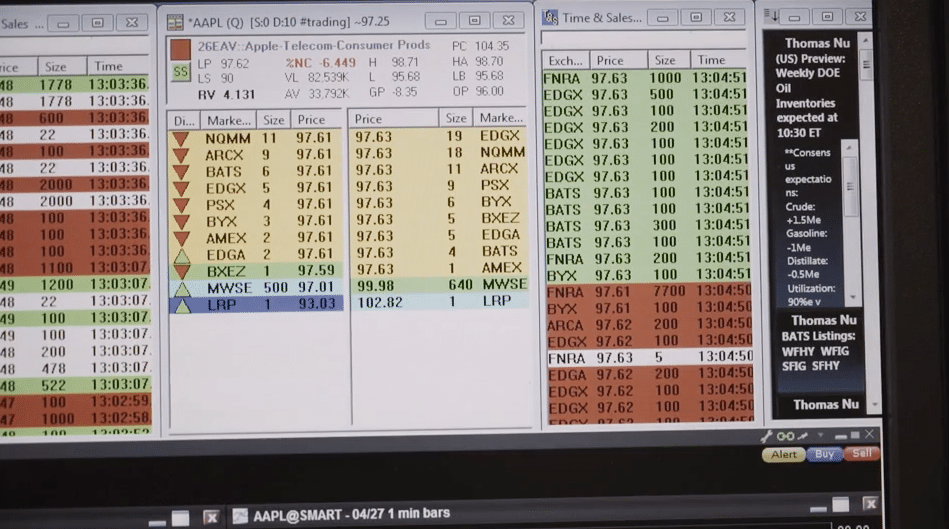
The market opened and URBN was bouncing around for the first ten minutes. The range started to tighten between 28.10 and 28.20. A seller at 28.20 could clearly be seen on the offer absorbing dozens of buy orders. I established a short and added to my position when the 28.10 bid dropped breaking the tight range. I continued to trade it on the short side for the next 30 minutes with my ultimate stop above 28.20.

I was looking at URBN because it had fresh news and was reacting strongly to that news in the pre-market. But the decision to open a short position was based on The Tape.

Steven Spencer is the co-founder of SMB Capital and SMB Training and has traded professionally for 16 years. His email is sspencer@smbcap.com.

No relevant positions

*live trades discussed in this post took place in T3 Trading Group, LLC a CBSX broker dealer

 
Learn how to read the order flow

Post to Twitter Post to Delicious Post to Digg Post to Facebook Post to Reddit Post to StumbleUpon


A Tape Trade

Jan 30th, 2012 | By sspencer | Category: Reading the Tape, Steven Spencer (Steve's) Blogs

One of the questions I receive most often is regarding trades based strictly on the tape. These occur far less frequently than in years past because of the masking of buyers/sellers by the HFTs but they still do occur from time to time. This morning I was trading AMLN on the Open as it was In Play due to an FDA approval.

It was gapping higher but had begun a pre-market downtrend so I was leaning short . I identified a seller at 14 and got short in the 13.90s.  It then proceeded to move up and down in a 20 cent range for a few minutes. With each passing minute I felt the likelihood of a profitable short trade diminished. As the 14 seller lifted I got long and was prepared for a move to 14.50-15.

For the next 10 minutes it continued to gyrate higher and lower. Finally at 9:50 I saw something that caught my attention. The bid was getting pounded at 14.05 and would not drop. I called this out to the desk and added to my long position. I placed a stop below 14.05 and waited. I was rewarded with about 50 cents of upside during the next 20 minutes. Not bad for a trade where I was risking a few cents :)

Steven Spencer is the co-founder of SMB Capital and SMB Training and has traded professionally for over 15 years. His email is sspencer@smbcap.com. For more information on SMB’s comprehensive tape reading program click HERE.

No relevant positions

*live trades discussed in this post took place in T3 Trading Group, LLC a CBSX broker dealer

Post to Twitter Post to Delicious Post to Digg Post to Facebook Post to Reddit Post to StumbleUpon


Why I was leaning short (RVBD)

Jul 20th, 2011 | By Bella | Category: Mike Bellafiore's (Bella's) Blogs, Reading the Tape

RVBD opened and held the 32 bid after gapping down miserably on the open.  It popped almost two points from 32 and then was dominated by an aggressive seller(s).  As RVBD made a pass at the 32 level from where it popped on the Open I got long again.  This is one of our favorite technical set ups.  But when it broke below 32 I started leaning heavily short.  Why?

1) An aggressive seller stepped down from the intraday high back to the 32 level.  The seller held all offers and immediately stepped lower when bids dropped.  There was no nuance to the selling.  Someone had a lot to sell and they were going low offer.  This was an aggressive seller to me and may foreshadow more selling to follow.

2) RVBD finally held the offer at/below 32.  On the open 32 could not hold the offer.  Below 32 was shown on the bids but if you watched the prints and inside market carefully noone was able to hold the offer at/below 32.  Now it could.

3)  RVBD made a new low.  31.85 had been the low on the open but now a new low had been created to the 70cish area.

RVBD did not drop quickly as I had hoped below the new low.  But this is not the only pattern after the new low for an end of the day close at the low intraday pattern.  It is possible that a Buy the New Low Program could be turned on the squeeze the shorts below 32 (me) and the shorts below the new low (me) to above 32.  And that is what followed.  It is also possible that this was a failed breakdown but because of the above that was not as likely.

So I shorted into the squeeze and used 32.35 and 32.50 as my stops.  I held.  When RVBD traded below 31.70 and was holding I thought I was about to profit handsomely and we would find lower ground quickly.  This did not follow.  31.50 is an important technical level on our longer term charts so that was to be considered.

RVBD did not follow through with a deeper downmove but I am content with my lean short for the reasons above.    Tomorrow we will watch below 31.50 as a short, above 32, above 32.35 and above 32.50 as possible longs.


Bella

One Good Trade

Post to Twitter Post to Delicious Post to Digg Post to Facebook Post to Reddit Post to StumbleUpon


Traders Ask- Fake Order Flow?

Mar 3rd, 2011 | By Bella | Category: Mike Bellafiore's (Bella's) Blogs, Reading the Tape

Dear Bella,
Thanks for writing your book as I’ve found it immensely useful!

Regarding order flow, I’ve heard people saying that institutions and big traders place large buy orders hoping other traders bid in front of those orders. The institution will then sell those bids. In many ways it’s a game of cat-and-mouse that often goes unnoticed by new traders.

How true is the above and if so, how would you react/interpret it in your trading? Could it be possible
that they are doing it to pump the stock price up in order to sell higher later?

Bella Responds

First I would like to offer a joking response.  Do institutions enter fake bids and offers to induce buys and sales in their favor?  Of course they don’t.  That would be so classless at best and unethical at worst.  That would never happen on the Street.  This is a place for gentlemen/women who only act in the best interests of the nation, like teachers and those serving.  Also if you found value from One Good Trade, would it kill you to make a stop on Amazon and leave a review:  http://amzn.to/fvN3p8 ?

Now for the answer.  Sure that can happen.  Remember we make trading decisions based upon three factors: intraday fundamentals, Reading the Tape, and Technical Analysis.  So a big order such as you described would only in unusual circumstances trigger a trade for us.  So really your question is when these big orders are placed what information can we learn as it relates to Reading the Tape?

There are patterns that you will spot from the Level II.  If you see fake bids going in to trigger sales on the offer, then when you see a big fake bid you know what it means.   An Old School trade was to spot a huge order in the NYSE Book and place a trade in the direction of that order.  There are still trades to be made following the side of a very large offer, but they are much rarer.   Also, more specifically in the late 90s we all knew that GS to the bid prominently on the Tape meant he was selling.  So we got short.

Trading is just a game of pattern recognition.  Spot the patterns and place excellent risk/reward trades.  Good traders do not spend much time caring whether an institution or HFT is trying to game the system?  They just decode the pattern and find ways to profit.

Mike Bellafiore

Author, One Good Trade

Post to Twitter Post to Delicious Post to Digg Post to Facebook Post to Reddit Post to StumbleUpon


Finding good setups in a quiet tape

Sep 17th, 2010 | By Joe Palau | Category: Joe P's blog, Reading the Tape, SMB Radar, Technical Plays

This blog is going to go over one of my recent trades in COG. Yesterday’s morning session was very quiet and I was having difficulty finding stocks that were really moving. I was able to establish during the first 15 minutes or so that I would trade a ‘range strategy” until the market structure changed. (more about this on another blog, stay tuned)  During these types of days I look to fade stocks having extended moves to resistance. I call this my ‘tape fade” trade.

To find my trades I first find a technical pattern I see and edge in and then find an entry using the tape. This setup’s success is pretty much given to the information I get from the tape, this is what makes this setup my highest probability trade in my playbook.

At 9:50 COG popped up on the SMB Radar and I put it on my screen, the stock was at 28.40. I noticed the stock was trading quickly to resistance so was looking for a spot to fade it. I then saw a 28.65 seller drop to 28.60, 28.55 was absorbing a ton on the bid. In this type of play I look to get short (fade the move) as soon as the buyer loses. It’s very likely that this will create a pullback in the stock or in the best case a reversal. I set my stop for this trade at the high of the move. Note that I am not picking tops, I am just following the big players in the stock and mechanically executing my setups. 28.65 ended up being the HOD, not bad for a trade with .10 of risk.

Follow me on twitter @joep_smb

Post to Twitter Post to Delicious Post to Digg Post to Facebook Post to Reddit Post to StumbleUpon


First Ticks – Wrong Ticks

Jun 5th, 2010 | By Adam | Category: Adam Grimes's blogs, Reading the Tape, Technical Plays, Trading Ideas, Trading Theory

Sorry for not posting this past week, but I have been struggling with some thoughts and plans for this blog. I have a very ambitious plan that involves laying out a foundation for technical analysis, sharing the tools I have found useful over the years, and also showing how these can be used in real-time. However, I want to be sure that once I start this project, I can commit to carrying it through on a regular schedule. In addition, I am trying to balance a planned course of attack on a deep subject with maintaining the ability to post on spontaneous and interesting topics as they arise… many conflicting interests to balance here, but I am close to figuring out how to do this. More on this soon, but today I want to share a small research project I did this week that reveals an important, but maybe not well-known, market tendency.

I spent several years focusing on and only trading the S&P futures. In that time, I did a lot of research on basic market tendencies, and (hopefully) also gained some intuition about the way this market moves. (As an interesting aside, I say I have only been trading stocks for the past 4 years, but maybe nearly 10 years of trading the S&P itself prepared me for this in some way.) Right after the market opens, I will often announce to the traders sitting near me something like “the first ticks are up, but that’s usually wrong.” This is an illustration of a tendency that is (as far as I know) specific to the stock market, that I like to call first ticks – wrong ticks.

Let’s drill down into this using the full history of the ES futures, which is 3,195 trading days beginning on 9/12/1997. When we try to quantify market tendencies, it makes sense to look at the long history, but also to focus in on smaller time windows to see if something has changed. Today’s stock market is very different from 1997, so let’s also examine the most recent trading year, extending back to 6/1/2009 which is 256 trading days. On one hand, it would seem to be very remarkable if we found tendencies that remained stable through years of bubbles and busts, through the structural changes of decimalization, the rise of electronic trading, HFT’s, algos, etc, but you might be surprised. Most of the tools I use work equally well on intraday charts of AAPL, daily stock prices from the 1700s or weekly grain prices from the 1300s, but that is a topic for another post. Throughout this current analysis, I will present stats first for the long history, then for the more recent window immediately following in parentheses. So, in this format, we are examining 3,195 (256) trading days extending back to 9/12/1997 (6/1/2009).

The ES futures reflect the price of the cash S&P index, plus an amortized risk-free rate, minus the dividend yield on the S&P 500. In normal conditions, this is a premium of a few points that converges to the cash value as the futures expire (quarterly), but futures currently trade at a small discount since the risk-free rate is so small. The minimum tick size is .25 of a cash S&P point, which corresponds to roughly .05 on the SPY. (I find the SPY to be a very poor market proxy due to the extreme level of noise.) First question: how many days have an immediate directional drive off the open, as opposed to trading in a noisy range? We can get a rough answer to this by looking at one minute bars and keeping all of the bars that have the open within one tick of the high or low. The assumption would be that one tick is noise, and the market went into an immediate directional drive off the opening print. We find that this happens 65.9% (64.8%) of all trading days in our sample, which might at first seem to be surprisingly large. (It is not at all surprising if you understand the Arcsine Law of Brownian motion and how it applies to random walks, but again, that’s another (even more nerdy) topic.)

So, we know that 2/3 of the time we will see a directional drive off the opening print. The second question to ask is, what should we do about it? Does it make sense if the broad market explodes off the open to pay offers and chase strength? Should we fade it? Do nothing? To really answer this question we would need to do an in-depth research project on tick-level data, but let’s try to tease something out with a back-of-the-envelope calculation sticking to our one minute bars. Let’s first look at how many times the market reverses, and trades on the other side of the opening tick, within the first 30 minutes. We find this happens 84.3% (80.1%) of the time, which is a very interesting statistic. Furthermore, we find that the average adverse excursion (how far the “fade trade” would move against us) is only .47 (.51) S&P points, and the largest move against us would have been 5.0 (3.0) full S&P points on 10/24/2008.  Note that this statistic does not tell us what the maximum directional move of the open was; it tells us specifically what the largest directional move for a failed drive off the open is. If you faded every single move off the open you would certainly experience more pain than this, but it also tells us that any move that drives more than a few points is not likely to reverse in the first half hour. This is also valuable information.

We can also ask how quickly the market is likely to reverse, if it is going to reverse at all. We find that that, on average, the first directional drive fails and reverses to the other side of the opening print in 4.3 (3.3) minutes. The median reversal time is 2 (2) minutes, and the ninth decile is 12 (7) minutes. For the purposes of this test, we considered any drive that did not reverse within the first 30 minutes a failure of this tendency, so there certainly were reversals many hours later that we are simply counting as failures to reverse.

We should also probably consider whether there is longer-term significance to this tendency, and one easy way to do this is to simply look at the relationship of the 10:00 print to the opening. We find that a fade trade after a directional drive off the open would be a winner from the opening print (which is pessimistic since if you are fading you should be positioned better than the opening print) 57.9% (63.9%) of the time, with an average win of .75 (1.0), and a median of .95 (1.50). Understand that we are only using this test to illustrate a market tendency. If we were trying to build a rule-based trading system we would need to do a lot more work, as there is certainly a better exit than just getting out at the randomly-chosen 10:00 print.

I know that was a lot to digest, but let’s simplify it: We need to use the S&P futures, rather than the SPY, because there is a little less noise in the futures. About two-thirds of all trading days will have a first one minute bar that is strongly directional, which we define as the opening print being within 1 tick of the high or low of that one minute bar. When we see this condition, we know that the first drive is quite likely to exhaust itself and cross to the other side of the open within the first 10 minutes or so. This is one of many little quirks or tendencies in the market that can be quantified. Taken together, many of these start to help a trader build some intuition and insight into how price action unfolds from a technical perspective.

Post to Twitter Post to Delicious Post to Digg Post to Facebook Post to Reddit Post to StumbleUpon


Reading the Tape In Multiple Time Frames

May 18th, 2010 | By sspencer | Category: General Comments, Reading the Tape, Steven Spencer (Steve's) Blogs

I was trading V today for the third consecutive day. My initial bias was short based on the weakness on the tape I had seen during the prior two days. During yesterday’s two point pop in the SPYs I found it to be very telling That V barely bounced. So I came in today ready to get short again. The futures were higher this morning so V offered a very nice entry point at the 76 level.

My initial short in V on the Open worked very quickly dropping from 76 to 75 in a heartbeat. Then over the next twenty minutes V continued to press up against the 76 level with shallower pullbacks. It was very easy to see on the tape the buyer stepping higher. First, 75.40, then 75.50, then 75.70 and eventually buying at 75.90 on the bid. This was “short term” strength on the tape. When V was dropping in price there were no aggressive sellers holding offers at lower prices. In isolation it appeared that V would eventually trade higher because buyers were being more aggressive than sellers.

But if you were to take a step back and think about V’s price action going back to its five point gap down on Friday the tape has been showing great weakness on a larger time frame.

1) On Friday after a large gap down from 85 V failed to hold above the longer term level of 79.50 and then trended down to 76 the next long term support level.

2) On Monday V trended down for the entire day touching 73.67 which is right above its next long term support area. They SPYs bounced from 112 to 114 and all V managed to do was trade up to 74.70.

3) And this morning it was being sold at the 76 level which is the long term support it dropped on Monday.

This is a stock that seemed set to head lower over the coming days. If things were to really start to get panicky a move to 65 was not out of the question.

Yet as I was trading it at 9:45AM this morning I allowed the short term strength in the tape to almost wipe my memory clean of the short bias I had entering the trading session. In my mind the big picture in the stock was running up against the tape in the stock. But that was the incorrect analysis.

Almost universally when we refer to “the tape” at SMB we mean the order fly that is occurring in a stock from minute to minute. But the reality is that traders on different time frames view “the tape” in different time frames as well. It is essential if you are making a longer time frame trade to give the highest weight to the tape in a longer time frame. That is where I momentarily went astray.

If I were attempting some type of scalp play then the momentary strength I was seeing on the tape would have been useful to establish a scalp long. But its only purpose for the trade I put on this morning was to indicate to me that I should take some risk off on my short and not add to my position until I found short term weakness on the tape to match the long term weakness I had identified during the preceding trading days.

In fact that is eventually what I did when I finally saw an aggressive seller at 75.12 put the kibosh on the 75.10 buyer. And I did this a second time when V was being sold at 74 and the large buyer at 73.89 got hit out for 94K shares. The weakness on the tape in the short term was matching the weakness of the tape in the longer term, which was my signal to be more aggressive.

Conclusion:

1) If you have a big picture trade idea use the short term alignment of the tape to press your advantage
2) If you have a big picture trade idea and the short term misalignment of the tape to take some risk off BUT don’t change your bias

Post to Twitter Post to Delicious Post to Digg Post to Facebook Post to Reddit Post to StumbleUpon


Its Probably Going Up

Feb 16th, 2010 | By sspencer | Category: General Comments, Reading the Tape, Steven Spencer (Steve's) Blogs

I started trading AAPL around 10AM this morning. I noticed it held its small gap from the Open and that each time it was dropping below 202 it would quickly recover. I also noticed that each time it popped above 202.50 that it would fail to hold the bid and drop back down.

My thought process was that AAPL had been strong on Thursday and Friday and since it held the opening gap that it would probably trade higher. I figured that if I could establish an initial position around 202 I had at least two points of upside. At 10:15 AAPL dropped to 202 but was only there for a few seconds. Opportunity lost.

At 10:20 AAPL started to trade between 202.40 and 202.50s. I bid for some stock at 202.42 and got long. I like when stocks start consolidating in a tight range close to their intra-day high. Its usually a sign the stock will trade higher. I also noticed an accumulation program. Each time the bids would get hit around 202.40 AAPL would immediately begin to tick higher.

I made a rookie mistake a couple of times and bought extra shares in the 202.50s. I saw an increase in volume and concluded the buyers had lost their patience and were going to have to bid the stock higher. I was wrong. I dumped most of the extra shares I had bought around 202.48 because I did not want to be caught with a large position if the 202.40 dropped and it quickly traded down to 202.

About five minutes later there was a surge in volume and I caught a one point up move. But I had very little size. Once AAPL clearly started to hold above 202.60 I bid for some more shares but couldn’t get hit. As it moved higher I bid above 202.70 and couldn’t get hit. The buy program was being more aggressive and cutting anyone who was interested in picking up shares on the bid.

This blog is the type of post trade analysis I do every day. I think about each aspect of significant trade I made during the day. I review my rationale for being in the trade and each part of my execution. I ask myself question like “Was I buying at the most favorable prices?”, “Was I aggressive enough?”, “Was I properly controlling my risk?”, “Did I take enough money out of the move?” etc.

The idea is to fire up the synapses and make sure that when a similar trade presents itself in the future I will trade it more effectively. Make this type of post trade analysis part of your game.

And by the way, if you are continually bidding higher for a stock and you can’t get hit its probably going up!

Post to Twitter Post to Delicious Post to Digg Post to Facebook Post to Reddit Post to StumbleUpon


A Trade2Hold- HAS Exit (if it trades against you)

Feb 8th, 2010 | By Bella | Category: Mike Bellafiore's (Bella's) Blogs, Reading the Tape

Who knew I was short the strongest stock in the market?  The stock gapped up.  Then buyers stopped paying the offer.  The stock broke its intraday uptrend.  And I shorted two lots with a Trade2Hold.  Well that didn’t work out.

HAS, Hasbro, reported before the Open and beat on revs and the bottom line.  Apparently someone is buying toys again.  On the one year chart there was no resistance.  HAS started an intraday downtrend.  34.30 held the offer on the tape.  I added more to my short position from 44c.

I entered stops of 31c, 36c and 60c got up and went to take care of a personal matter.  When I returned I was completely flat in HAS.  Well that is not good.

The teaching principle for this trade?  For Trades2Hold we must set stops if the stock trades against us.  When trading multiple lots we need multiple stops.  I close out almost all of my positions manually but with Trades2Hold I will use stops.  For a Trade2Hold you cover only when there is a Reason to Cover.  And one such reason is if the stock trades against you, hitting a price that you set as your stop.

There was too much bid buying on the way down.  Stocks like HAS that gap up almost never buy so much stock on the way down.  They drop out and the tape foreshadows the weakness generally.  My short position ambition was bigger than my trading senses.

Overall this was a good trade.  I opened an excellent risk/reward short.  But HAS wasn’t weak enough on the tape for me to be short two lots.

Later I learned that I had started this short in the strongest stock in the market.  Brilliant Bella!  Above 34.60 I did start a long position and a tweet exchange with @sellputs about its chances of trading well through 35.  @sellputs wasn’t optimistic.   I held not seeing any weakness on the tape yet cautious of price.  HAS closed strong, but well below 35 and is on my radar for tomorrow-especially above 35.15.

Best of luck with your trading! Don’t forget to follow us on Twitter.

Long HAS

Post to Twitter Post to Delicious Post to Digg Post to Facebook Post to Reddit Post to StumbleUpon


Watching Order Flow and Tape Reading To Find Good Trades – TraderInterviews.com

Jan 7th, 2010 | By smbcapital | Category: Gilbert Mendez's (Gman's) Blogs, Reading the Tape, SMB In The News, Trading Psychology, Trading Theory

Gilbert “Gman” Mendez, head trader at SMB Capital, sat down for an interview with Tim Bourquin from TraderInterviews.com. In the interview Gman discussed his trading style and how he has adapted to the changes in the Market because of HFT.  Gman also highlighted the importance of reading the tape, and why he chooses to trade stocks that are in play.  Read or listen to the interview here.

Post to Twitter Post to Delicious Post to Digg Post to Facebook Post to Reddit Post to StumbleUpon