Archive for December 2008

That’s NOT a Short!

Dec 31st, 2008 | By Bella | Category: Mike Bellafiore's (Bella's) Blogs

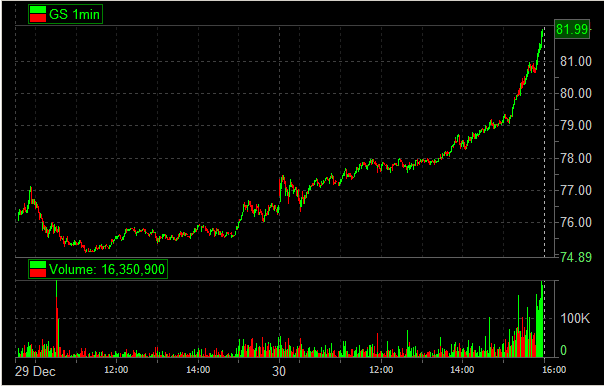
Yesterday one of our most improved traders was trading GS.  Great stock to be in.  Great job of being in when many were taking off.   This talented young trader, let’s call him MROD, developed a detailed trading plan for GS.  MROD saw that 80 was resistance on the longer term chart in GS, remembered that the last time it saw these levels it traded just a bit thru to 80.10, and developed a plan to short GS at 80.10.  This was all excellent.  But then it got ugly.  And he started shorting when GS was NOT a short. Let’s discuss.

On the longer term chart resistance could be found at 80 in GS.  The next levels for us were 82.20ish and 87ish.  We trade a short term style so if your levels are different understand our different trading time frame.  And MROD wanted to short at 80.10 because of his memory trading GS.  I really like this short.  Not for huge size.  But I like the idea.  The longer term significant resistance level trumped the intraday low volume uptrend.  I like that he remembered how GS traded and a level not necessary recognizable on the chart.  I like the fact that he was not a slave to the chart and factored in how GS traded.  This was all terrific.  And GS had trouble trading above 80.10 yesterday at first.  This was a really solid, thoughtful trade.

But then GS traded above 80.10 and MROD shorted the 80.20.  And then GS went higher and I heard a few others on our desk short GS at 80.35.  MROD tried to short GS again at 81.  This is not good.  GS above 80.10 and especially 80.20 is just not a short.  The level was 80, 80.10.  And now GS is above this price.  Now granted the volume was light but it is still was not a short.  GS had been in an uptrend for four hours intraday.  GS was now above the 80 level.  The next level was not for points.  There was not evidence watching the Box that GS was about to trade lower.  Now maybe because of the light volume GS was not a long for you yesterday.  But above 80.10 it is not a short.

I perfectly understand what some on our desk were thinking.  One of our new traders and I discussed his confusion about GS’s upmove yesterday before today’s Open. There was no news catalyst that was announced yesterday.  GS had trouble trading above 78 and now it’s above 80 with no news.  This doesn’t make sense.  GS cannot trade higher.  Sure it can.  And there was one very good reason that some of our younger traders had not considered, which we discussed at our SMB AM Meeting.  And there was really no reason for them to consider this other than Steve and I kept commenting on what might be happening throughout the day.  So what was this mysterious catalyst yesterday?  The stock was being marked up.

At the end of the year stocks can get marked up.  Someone wanted GS higher.  There are many reasons why.  Maybe some have GS in their portfolio and a higher GS will make their portfolio more attractive to investors.  Maybe some need GS higher for an options play.  Whatever the reason GS acted like a stock being marked up.  So in the back of your mind when trading GS yesterday you needed to understand that the desire to mark GS up could be a catalyst.

Stocks above resistance are almost always not shorts.  Fighting the tape above resistance will manifest a frustrating and short-lived trading career.

Happy New Year!  

GS 3-Month

GS 2-Day

Post to Twitter Post to Delicious Post to Digg Post to Facebook Post to Reddit Post to StumbleUpon


ROH Bounce

Dec 30th, 2008 | By Bella | Category: General Comments, Mike Bellafiore's (Bella's) Blogs

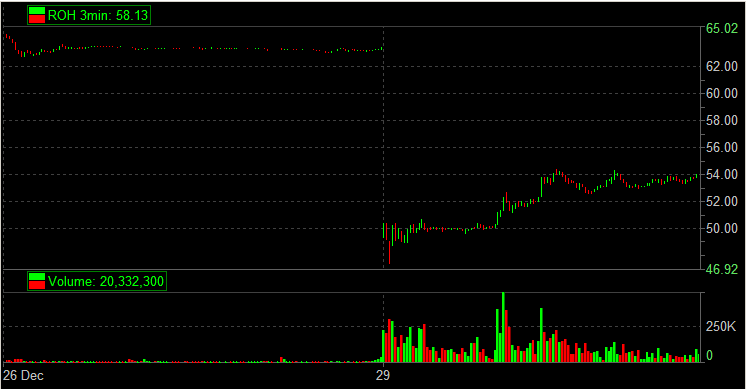
ROH tanked on the Open yesterday. Fading it on the long side was like trying to catch a falling knife. And many of you have heard the Street expression “don’t catch a falling knife.” These tank jobs in ROH happen everyday. As we discussed during our SMB AM Meeting, it is a mistake for a new trader to try and catch the bottom. Let’s discuss.

It is human nature for some traders to try and catch the bottom of the market or a stock. Some wish to be that one trader who was correct while others on the Street were wrong. Some desire to be that guy on the desk who calls the bottom and receives the adulation from other traders. But this is just ego. And trading to stroke your ego will manifest a short trading career. The object is to make money consistently. Not try and prove you are smarter than others.

You will make the most money in a bounce after the market or a stock has stabilized and held higher. Trying to get long at 47.50 yesterday, though the bottom in ROH yesterday, is bad trading for new and most experienced traders. Often traders will comment that a stock feels like the bottom. And that may be the case. But with a stock falling quickly your feel must be confirmed by the price action.

But what is most interesting about these patterns is that there is no money trying to catch the bottom for a new trader and most experienced traders. 1) You will be wrong sometimes and take huge rips when the stock is not at the bottom. 2) Even if you catch the bottom you will be unsure whether it is the bottom. This will cause you to sell too quickly too often. A stock often looks the worst at the bottom. There will be signs of weakness near the bottom. The sellers are still concerned with dumping their shares. And buyers are still cautious to take a big position. And when you see this weakness you will most likely sell too early into the beginning of the bounce and thus miss the huge upmove.

The money trading a bounce is in waiting for the stock to bottom, seeing the stock hold higher, and then getting long. Also if the stock is going to bounce let the stock breathe when it first starts to trade higher. ROH traded up 2 1/2 points, found some support at 50, and then traded 4 points higher. You want to be in the move from 50-54. This is where the easy money is. This is where your win rate is 60-70 percent with an upside of at least 5 and a downside of 1. This is a play where you will consistently make money.

Now there are some experienced traders who pick bottoms. And they play these stocks for retracements. This is for experienced traders. And this is a very difficult trading technique. Even for an experienced trader I would suggest following trends. There is more money to be made. And your results will be more consistent trading with the trend of stocks in play.

You will see chart patterns like ROH again. Let the stock stabilize and hold higher. Then and only then should the new trader get long. And then let the stock run. Do not sell at the first sign of weakness. Play for a bigger chop than normal.

Best of luck with your trading!

ROH Chart

Post to Twitter Post to Delicious Post to Digg Post to Facebook Post to Reddit Post to StumbleUpon


Holiday Trading

Dec 28th, 2008 | By Bella | Category: General Comments, Mike Bellafiore's (Bella's) Blogs

I did it again. I do not know what is wrong with me.  I definitely have a problem.  I had about 15 cookies last nite. Delicious! I just can’t stop. If I eat one then I will eat 15.

I went to three XMAS parties this week. That was one too many.

I did not trade very much last week. I missed Monday because I was sick. Tuesday I traded RHT. The rest of the week I was with family. But I am going to trade on Monday.

It’s funny even though I have traded for over 11 years when I miss a few days I feel out of it. I feel like I will not have a good feel for the market. I am a bit anxious as I write thinking of trading on Monday after being away for a few days.  And I always feels like this when I have missed a few days. I wonder if I will be prepared to trade tomorrow since I missed a few days last week. And I only missed a few days.

But tomorrow I will trade lightly. I have missed a few days. The holidays are still here so volume will be light. I will focus on a Stock in Play. I will probably stop trading after the Open and just wait for the Close. I will lower my tier size. I will wait for my best trading setups. I will spend some more time preparing for the Open. I will trade carefully and work on regaining my feel.

If you are going to miss a few days over these holidays or have missed a few days, then take it slow. Regain your feel. It is ok to be off just a bit since you missed some screen time. It might take you a few trades to get your timing back. Be aware that you do not have the same information that others who have not missed a few days may have. And the one thing you do not want to do is rip it up because you have been away for a few days. That is a huge mistake.

Good luck with your trading!

Post to Twitter Post to Delicious Post to Digg Post to Facebook Post to Reddit Post to StumbleUpon


Learning from “Outliers”

Dec 26th, 2008 | By Bella | Category: Mike Bellafiore's (Bella's) Blogs

One of the great lessons of trading is how little you know. You must constantly learn. I have to admit I didn’t quite understand what a credit swap was till recently. I was in an interview with a very bright young woman who explained to me what she did as a credit derivatives trader. I didn’t get the whole thing but I learned a little more. One of these days I will fully understand.

Often there are great lessons for us from non trading books. As a trader you ought to read. Steve is always sending me interesting articles from all different sources. Be like him. You ought to read as much as can. You should read about companies. You should read about how companies make money. And how these companies are connected to other companies. But you should also just read.

Dr. Steenbarger wrote an excellent post the other day and referenced one of my favorite writers Malcolm Gladwell. I just love how Gladwell teaches us through interesting stories. I read his last work “Outliers” in a day. Mr. Gladwell offers us much to learn as a trader inside of “Outliers.” Let’s discuss what Mr. Gladwell can teach us as traders.

1) It takes 10,000 hours to master a topic. For you new traders who are struggling in your first few months please think about this. Do the math. If it is gonna take you that long to become a master of trading than the first few months should not be overvalued. Slow and steady wins the race.

2) Successful people work very hard. If you want to become a great trader you will have to put in the time. Just like almost every other successful person has had to do.

3) We can change. We have personality traits that may have just been handed down to us. If we recognize this then maybe we can change some of the ones that are not in our self interest.

4) Successful people all were given opportunities. Many believe that the next two trading years will be bountiful with opportunity. With the advent of new ETF’s there are more opportunities for traders. Further with the ability to record our screens we can practice. Again more opportunities. This is all we can ask for.

5) Trading is meaningful work. Gladwell defines meaningful work as: “autonomy, complexity, and a connection between effort and reward.” Traders have autonomy to choose the stocks they trade and their entry and exit points. Trading is complex. And the harder you work the more you can make. Your upside is unlimited.

Happy holidays!

Post to Twitter Post to Delicious Post to Digg Post to Facebook Post to Reddit Post to StumbleUpon


Why Trade Stocks in Play?

Dec 22nd, 2008 | By sspencer | Category: General Comments, Steven Spencer (Steve's) Blogs, Trading Theory

SMB Capital trades Stocks in Play.  Our traders are taught how to find such stocks.  And during our SMB AM Meeting we review the best Stocks in Play for a particular trading day. Over the past few years I’ve had quite a few conversations with interviewees, including “experienced traders”, about this core trading philosophy. Some don’t seem to grasp the importance of this principle. Let me explain.

Our ability to make money consistently as intraday traders relies on our high daily win rate. If you ask any professional trader how many days they are net positive each month they can give you that figure. It is between 80-90% for almost all successful traders (a few on our desk are consistently above 95%-think GMan). How can professional traders have such a high win rate? There are three basic reasons for such a high level of success: 1) they develop a skill set over time that allows them to get in and out of stocks efficiently 2) they develop pattern recognition skills that enable them to accurately assess their risk versus reward and 3) they are in the RIGHT stocks.

The RIGHT stocks are those that we have identified as Stocks in Play. These stocks will have greater order flow than normal. This does several things that give our traders an advantage: 1) increased order flow increases liquidity which allows us to risk less on each entry and exit from a position; 2) the greater order flow creates additional volatility which leads to many favorable risk/reward scenarios during the day; and 3) the large number of orders will overwhelm the dopey algorithmic trading programs which results in a stock moving more cleanly.

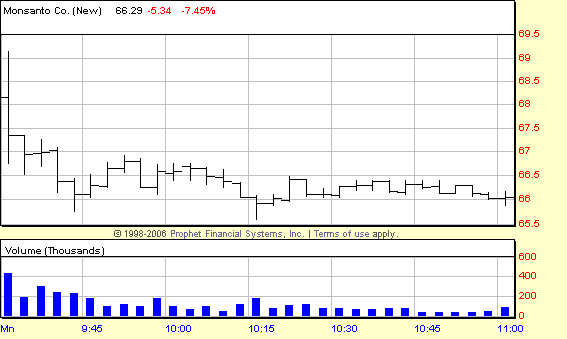
If a stock is in play then there is a 95% chance that I will make money trading it.  During our SMB AM Meeting on Friday we highlighted RIMM as a Stock in Play.  19/22 traders were net positive trading RIMM.  I can even make three or four losing trades in a row. But by the end of the day I will be presented with so many trading opportunities that I inevitably finish positive in the stock for that day. Today I traded MON and AAPL. Both were In Play and I had no difficulty making money in them.

There is one other point I want to make about stock selection. Sometimes I am unable to identify a stock that fits my criteria for being In Play and I will trade an ETF or a momentum stock because both have a tendency to make several good moves each day. But my first choice is always to be in a Stock In Play.

Happy holidays.

Intraday Chart AAPL

Intraday Chart MON

Post to Twitter Post to Delicious Post to Digg Post to Facebook Post to Reddit Post to StumbleUpon


Build from a Base

Dec 21st, 2008 | By Bella | Category: Mike Bellafiore's (Bella's) Blogs

Those who trade wish to make a lot of money. Traders are not trying to make $200 a day. They want to make much more. And often traders are ambitious. And they have rarely failed at anything they have done before. Perhaps they have been told their whole life that they were special. Most are the smartest person in most rooms. They are uninterested in being ordinary. And they aren’t. But all of this can be damaging.

So these special, ambitious people start to do some thinking. On a treacherous, rainy day like today in NYC they might let their minds wander. I am ready to start making some serious money they may think. I really need to lay into some stocks with more size certainly will be considered. I would look really cool in that new Benz on the back of the News today. I am better than that Red Dradle (trader who made 15k in a session and a half of trading, and my new nickname for one of our better new traders). I WANT TO BE THE MAN!

Just some advice. You shouldn’t try and make 5k a day by losing 5k. You shouldn’t do this after 10 years and you certainly shouldn’t do this when you start. Often new traders think their ability to lose a lot symbolizes their potential to make much more. No it doesn’t. You should never lose more than 1/2 of your median intraday gains. If you are making 1k a day, and a down day previously for you was -500, then now allowing yourself to lose -5k doesn’t mean you will now be able to make 5k. It means now you can lose 5k. And some new traders just don’t understand this.

If you want to make 5k a day you must first be able to make $500 consistently (downside of $250). Then you must show that you can make $750 consistently (downside $375). Then you must demonstrate that you can make $1k consistently (downside $500). Then $1500 (downside $750). Then $2000 (downside $1k). You get my point. But for some very strange reason traders think making that jump from 1k to 5k requires them to lose 5k in day. Again no it doesn’t.

You build from a base. You build from your profitable base. The way to make more is to make more while contemporaneously not exposing yourself to proportionally greater downside risk. And if you can’t make more than 2k in a day with a downside of $1k then stay at this level for awhile. There is nothing wrong with making that kind of money. Keep pushing yourself to get better. But do not force it.

One of the smartest traders on our desk has been making $600 a day the past few months. And I know he wants to make more. And one day he will. But he forced it this week. And he didn’t make more than $600. He took a huge rip. He took a rip that will set him back weeks.

I was talking with Steve about this the other day. And he got very animated. Steve is ultra calm so it is amusing to watch him get animated. But it usually means that he is about to make a very good point. And he did. Steve shared that traders who are making $600 a day can’t take these rips for another very important reason. Unlike Steve or myself they cannot make back $5k. They do not have the skills. If Steve rips up 5k he can make that back in less than an hour. But a new trader cannot. If you are making $600 a day it will take you weeks to make back a huge rip. And this game is about putting money in your pocket not throwing away a few weeks worth of gains.

So build from your positive base. Push yourself to get better. But do not force your progression. Losing more means you can lose more. It doesn’t mean you can make more.

Best of luck with your trading!

Post to Twitter Post to Delicious Post to Digg Post to Facebook Post to Reddit Post to StumbleUpon


The Right Daily Stop Loss Amount

Dec 20th, 2008 | By gman | Category: Gilbert Mendez's (Gman's) Blogs

There is a fine line between failing and making it as a trader. Whether you trade with a prop firm or trade for yourself it is important to have an appropriate stop loss. Having too small of a daily stop loss will keep you out of the game too many times and will impair your ability to grow as a trader. On the other hand, having too big of a daily stop loss will either break your account quickly or will put you deep in the hole during a slump.

I believe your stop loss should be proportional to the size of your bankroll and your level of experience. If you are a beginner trader, your stop loss should be smallest even if you have a large bankroll. As a rule of thumb your daily stop loss should be no more than 2% of your trading capital. And it should allow you to trade with the smallest size possible of 100 shares. In addition, for you active traders, your stop loss should accommodate your trading style such that it should take you several consecutive losing trades to reach your stop loss.

This last point is very important. You must get enough screen time in order to get better when you first start your career. Having a daily stop loss that allows you to take at least 8-10 consecutive loses in one day is crucial to your success. If your current system/stop loss combination does not allow you to do this then you have to consider lowering your tier size (assuming you are trading with more than 100 shares), being more patient and/or more disciplined. If you are already trading with 100 shares and have trading capital limitations, you must work on your trading system to make sure that you get enough screen time.

For those of you more experienced active traders trying to get bigger and better traders this latter point is quite important as well. You need sufficient data to help you identify what you are doing well and wrong. Getting stopped out on the opening session after a couple of consecutive losing trades is not the way to do it. And certainly increasing your stop loss to accommodate your recklessness is not the solution either! If this is you, you need to work on your tier size primarily, but this is a topic for my next blog so I don’t want to get ahead of myself here.

Now, for those of you more experienced there is one more thing you need to consider for a correct daily stop loss. That is, your stop loss should be no higher than about half of your average daily profit. Specially if you are the kind of trader who makes money 50-60% of the trading days in a month. This is even more important for those of you in a slump. Seriously the last thing you want is to spend the next couple of months making back the money you ripped up during a two week slump.

Your focus during the first six months of your trading career should be on learning this craft. Everyone must have well selected stop loss, should stick to it religiously AND you should not reach it often. You should not reach your stop loss more than twice a month. If you find yourself reaching your stop loss more than that then you should cut your size in half and focus on the fundamentals and plays that make you money. The point of the daily stop loss is to limit your risk in days when you are not feeling the market. Remember that you have a long career ahead of you, and having an appropriate stop loss will ensure you stick long enough to enjoy it. Enjoy your weekend.

gman

Post to Twitter Post to Delicious Post to Digg Post to Facebook Post to Reddit Post to StumbleUpon


What if I am Wrong?

Dec 19th, 2008 | By Bella | Category: Mike Bellafiore's (Bella's) Blogs

I made some chops trading RIMM afterhours yesterday. More importantly I learned important levels. A ton of volume was done at 41 and 41.40 was a huge seller. Today my game plan was to aggressively buy if RIMM traded above 41.40. I was wrong.

I had expected RIMM to fly after it held above 41.40. It didn’t. There was a ton of selling at 60c and 65c and 70c and 75c. RIMM never traded above 41.80. When I bought aggressively above 41.40 I was playing for a big move. And that was what I was expecting. Again I was wrong.

When you are developing your game plan before the Open you must consider how to protect yourself if you are just wrong. So when RIMM was not flying above 40c I lightened up. When it went higher I would buy some more. When it was not flying at these higher prices then I lightened up again. I was very long when RIMM was ticking up. I would have been in an explosive upmove with size. But also I would have been out of RIMM if it tanked and avoided a rip. I held a core position but I sold my second and third lots when the stock did not do what I had expected.

So as a I write I am positive for the day. I was completely wrong with my game plan but I did not take a huge rip. A good intraday trader can make money even when their bias is wrong. No one cares what I think about the correct price of a stock. What is important is price action. If the stock is flying then I am correct. If the stock is not flying, then I just might not be correct. And I must lighten up.

I have built my trading system backwards. How do I make money without risking losing money?  Defense first.  After all it is my money. If my trading account is negative then I have lost MY money. And I am not interested in losing MY money. I am not interested in ever exposing myself to a huge rip. There are plenty of trading opportunities that offer me little risk and a good reward. I just wait for those plays. And I always ask: what is I am wrong?

BTW if RIMM holds above 41.80 I will aggressively trade it from the long side. But I might be wrong.

Intraday Chart of RIMM on Earnings

Best of luck with your trading!

Post to Twitter Post to Delicious Post to Digg Post to Facebook Post to Reddit Post to StumbleUpon


Push Yourself to Become Better

Dec 18th, 2008 | By jtomasulo | Category: General Comments, Jeff Tomasulo's Blogs

I read Bella’s blog on SRS and he brings up a great point on how important it is to push yourself everyday to become better. “Constant never ending improvement,” I think Tony Robbins said that one. But the reality is the SRS, SKF, and USO’s of the world are basically different opportunities for us as professional traders to make more money. If you shun them you are limiting yourself and your potential. Can they be scary? Yes. Will they make you feel uncomfortable? Yes. The first time you look at them you think, there is no way I can make money in them. But there is a simple process I used and learned when, like Bella, the Internet craze started.

First you need to be prepared. Find out what the heck is the SRS, SKF or whatever ETF or product you are about to trade. What do they represent? Look at long term charts, then work down to weekly, daily and then intraday. Also, find out if there are any indicators that will help give you the edge of showing you where they might be headed, like the IYR’s, SPY’S and XLE’s, etc. Overlap the charts and see if you can find patterns. Be good information gatherers.

Second, you need to start off by just watching. Be a sponge and learn as much about how the product moves. See how they react to news in the market and the sector they represent. Figure out what kind of range they trade in and what kind of spread they have. Also, learn the potential they have when they finally do move.

Third, try and figure out what the true risk reward is. This means different things to different people, but I want to know that when I am wrong, what will I lose if I buy 100 shares, 200, 1000, 2000 , etc. And how much I will make if am right if I buy X amount of shares.

Finally, when I have all this information, I START SMALL:100 shares. Then as I get comfortable with how they move I start to increase my position size. I was never good at being the person who traded 500 shares one day and then 5000 the next. Everybody’s personality is different, so know yourself and how much to push. One note of caution, like everything I trade only trade the product when it is in play, especially the ETF’s that I mentioned. Over-trade these products and you will lose money.

Understand you will feel uncomfortable at times and that is good. Embrace those feelings. When I am out of my comfort zone it means I am pushing myself to get better. I believe this process can be used not only trading momentum stocks, but basically any new product you are interested in trading. By putting this process in place it will save you unnecessary loses and unnecessary emotional trauma. Plus, it will make you a more consistent and well balanced professional trader.

Jtoma

Post to Twitter Post to Delicious Post to Digg Post to Facebook Post to Reddit Post to StumbleUpon


Take Your Normalcy and Shove It

Dec 18th, 2008 | By Mark McLean | Category: General Comments

Recently there’s been more talk and trading of certain ultrashort ETF’s on our trading desk. It seems as the downside move in SRS from over 270 was missed and it cracked 100 that the popularity rose as maybe a trade-worthy stock. So, though I am not certain of this, the stock seems to be more heavily traded at these prices, but probably for good reason.

Understand that as a momentum trader myself, I thoroughly enjoyed the reckless behavior of SRS above, say 130. Trading the stock with more than 400 shares was just crazy, as 100 and 200 shares was more than enough to be able to safely manage risk while at the same time taking great profits because of the constant 2 to 4 point moves. The stock was consistently up or down over 25 points, and with light volume and well placed trades you were making a very good profit. Levels weren’t much of a concern because the stock was trading in realms it had not seen before. And because of that you were not even overly concerned with your price, rather that you were on the right side of the ensuing 4 point move. As you were in a profitable trade, the mentality was not that “maybe I should cover that this price because of resistance”, rather that “I should cover here because I am 3.50 pts in the money and any more is just greed”. And that, my friends, was great.

Fast forward to present day. SRS has sold back down below 100, and is trading at a dismal $60 as I write this blog. The spread is a simple 2 to 5 cents, and size is actually acceptable to trade with. It has garnered attention as a stock below $75 that still moves, and I have to listen to even the most simple minded trader’s thoughts of where it might go to. Save for a random 1 1/2 point move, it is almost, near, normal. And now disgusting. Maybe not disgusting but definitely not fun anymore. And the reason is probably related to the fact that as this market is finding some footing, a real estate “ultrashort” may not be the hot topic as the fed cuts rates and buying opportunities start to become more prevalent.

All that is probably another topic which I may touch on later. For now, I prefer to use the idea one of the Joker’s monologue in the recent “Batman, Dark Knight”: “Introduce a little anarchy, you upset the established order, and everything becomes chaos. I am an agent of chaos. And you know the thing about chaos? It’s fair.”; Chaos = market volatility with SRS as a prime example? Yes sir. Those were the good times. That unsure recklessness that fills a day of trading with the emotion of bid hitting, or in the case of SRS, paying 50 cents through to get long. Those are my days of good. Someone took the face paint and lipstick off of SRS. Because all of this normalcy? Feel free to shove it.

Post to Twitter Post to Delicious Post to Digg Post to Facebook Post to Reddit Post to StumbleUpon